Why I Started Qigong for Daily Body Tune-Ups — And Never Looked Back
You don’t need hours at the gym to feel balanced and energized. I discovered qigong through a friend’s casual suggestion, and honestly, I was skeptical at first. But after just a few minutes a day, I noticed real shifts—less stiffness, clearer focus, and a calmer mind. This ancient practice isn’t about intense workouts; it’s about gentle, intentional movement that supports long-term body maintenance. If you're looking for a natural, low-effort way to stay in tune with your body, this might be it.
The Daily Grind That Led Me to Qigong
Like many women in their thirties and beyond, life had settled into a predictable rhythm: early mornings preparing meals, long hours at a desk job or managing household responsibilities, and evenings spent catching up on chores or helping children with homework. Screens became a constant companion—laptop during work hours, tablet for recipes, phone for messages, and television to unwind. Over time, the physical toll began to show. Shoulders stiffened by midday, lower back ached after standing too long, and energy levels dipped sharply in the afternoon. Sleep, once reliable, became fitful. Waking up felt less like renewal and more like bracing for another round of demands.
I tried common fixes: over-the-counter pain relievers for tension, caffeine to push through fatigue, and stretching videos when motivation struck. These offered temporary relief, but never addressed the root of the discomfort. The stiffness returned, the mental fog lingered, and the sense of being constantly drained persisted. I wasn’t injured, but I wasn’t thriving either. It was during a weekend visit with an old friend that I first heard about qigong. She mentioned how she’d started doing ‘a few quiet movements’ each morning and felt more centered. I dismissed it at first, assuming it was another trend. But her calm demeanor and steady energy stayed with me. Curiosity, not desperation, led me to give it a try.
What surprised me most was how little time it required. Just five minutes. No special clothing, no equipment, no need to leave the house. The movements were slow, deliberate, and surprisingly soothing. Within a week, I noticed my neck felt looser when I woke up. By the second week, I caught myself taking deeper breaths during stressful moments. This wasn’t a dramatic shift, but a quiet recalibration—one that made daily life feel more manageable. The daily grind hadn’t changed, but my body’s response to it had begun to shift.
What Exactly Is Qigong? (And What It’s Not)
Qigong (pronounced “chee-gong”) is a mind-body practice with roots in traditional Chinese medicine, dating back thousands of years. At its core, it combines gentle physical movements, controlled breathing, and focused intention to support the body’s natural ability to maintain balance. The word itself comes from two parts: “Qi,” often translated as vital energy or life force, and “gong,” meaning cultivation or practice. Together, qigong means “cultivating energy” through consistent, mindful effort. It’s not about generating mystical powers or performing supernatural feats. Instead, it’s a practical system for tuning into the body’s rhythms and supporting its innate capacity for healing and resilience.
It’s important to clarify what qigong is not. It is not a martial art, though some styles share historical connections with practices like tai chi. It does not require any religious belief or spiritual affiliation. You don’t need to adopt new philosophies or change your worldview to benefit from it. It’s also not intense physical exercise. Unlike high-intensity interval training or weightlifting, qigong emphasizes softness, fluidity, and internal awareness. There’s no goal of sweating, straining, or pushing limits. The focus is on quality of movement, not quantity. You won’t build bulky muscles or burn hundreds of calories in a session. What you will develop is a deeper connection to your body, improved coordination, and a greater sense of internal calm.
Modern science has begun to explore the mechanisms behind qigong’s benefits. Studies suggest that regular practice can influence the autonomic nervous system, shifting the body from a state of stress (sympathetic dominance) to one of rest and recovery (parasympathetic activation). This helps explain why many people report feeling calmer, sleeping better, and experiencing less tension after just a few sessions. While the concept of “Qi” may sound abstract, researchers often interpret it in physiological terms—such as blood circulation, oxygen delivery, or nervous system regulation. Whether viewed through an ancient or modern lens, the outcome is the same: a practice that supports whole-body wellness in a gentle, sustainable way.
Why Quick Daily Practice Beats Occasional Intensity
One of the most powerful lessons qigong taught me was the value of consistency over intensity. In a culture that often celebrates extreme workouts, dramatic transformations, and quick fixes, the idea of spending just five to ten minutes a day on gentle movement can feel underwhelming. But research in behavioral science and physiology shows that short, frequent practices often yield more lasting results than sporadic, high-effort sessions. The body responds best to repetition and routine. Just as brushing your teeth daily prevents dental problems more effectively than an occasional deep cleaning, small daily movements help maintain physical ease and prevent the accumulation of tension.
Consider the difference between exercising intensely once a week and moving mindfully every day. The weekly workout may leave you sore and depleted, making it harder to return. The daily practice, by contrast, becomes a ritual—a quiet moment of self-care that reinforces your commitment to well-being. Over time, these micro-sessions add up. Improved circulation, better posture, and enhanced nervous system regulation are not the result of a single breakthrough but of repeated, gentle stimulation. A 2018 review published in the Journal of Evidence-Based Integrative Medicine found that even brief daily qigong practice was associated with measurable improvements in balance, flexibility, and stress reduction among middle-aged and older adults.
Another advantage is accessibility. You don’t need a gym membership, special shoes, or a large space. You can practice beside your bed, in a quiet corner of your kitchen, or even at your office desk during a break. There’s no fitness level required—movements can be adapted for sitting, standing, or limited mobility. This low barrier to entry makes it easier to stick with over time. Unlike ambitious fitness goals that often lead to burnout or injury, qigong invites you to meet your body where it is, without judgment. It’s not about performance; it’s about presence. And that makes all the difference when building a habit that lasts.
My Go-To Morning Routine: 3 Simple Movements That Set the Tone
My personal qigong routine takes about seven minutes and has become a non-negotiable part of my mornings. I do it right after brushing my teeth, before making coffee. It’s not about achieving perfection—it’s about showing up for myself. The sequence is simple, yet profoundly effective. I begin with Gentle Neck Rolls, a movement that releases the tension most of us carry in our shoulders and upper back. I stand with feet shoulder-width apart, knees slightly bent, and slowly roll my head in a half-circle—from chin toward chest, up to the right shoulder, and back to center. I repeat this on the left side. The key is to move slowly, like water flowing downhill, and to coordinate the movement with my breath: inhaling as I lift, exhaling as I lower.
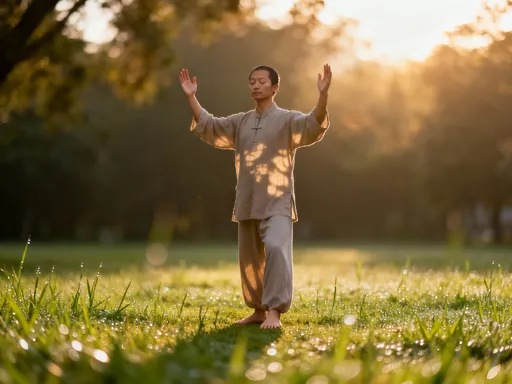
The second movement is called Rising Hands to Heaven. I start with hands resting at my lower abdomen, palms down. As I inhale, I slowly lift my arms forward and up, turning the palms to face the sky. At the peak of the motion, I imagine gently stretching the space between my fingertips and the crown of my head. I don’t lock my elbows; there’s a soft bend to keep the movement fluid. As I exhale, I lower the arms back down, palms turning inward, returning to the starting position. This movement stimulates energy flow along the body’s central channel and encourages deep breathing, which activates the parasympathetic nervous system and sets a calm tone for the day.
The third and final movement is the Waist Loosening Twist. With feet planted firmly, I place my hands on my hips and gently rotate my torso to the right, keeping my lower body still. I take three slow breaths in this position, then twist to the left for another three breaths. This warms up the spine, improves joint mobility, and gently massages the internal organs. I focus on keeping my movements smooth and my breath steady. If I’m feeling particularly stiff, I reduce the range of motion—there’s no need to force anything. The goal is not flexibility but awareness. After these three movements, I stand quietly for a moment, hands resting at my lower abdomen, and notice how my body feels. More often than not, I feel lighter, more alert, and better prepared to face the day.
How Qigong Supports Whole-Body Maintenance
While the immediate benefits of qigong—like reduced stiffness and mental clarity—are easy to notice, the deeper effects unfold over time. One of the most significant changes I’ve observed is in my digestion. I used to experience occasional bloating and discomfort, especially after meals. Since incorporating qigong into my routine, those episodes have become less frequent. While I don’t claim qigong cured anything, the gentle twisting and abdominal breathing seem to support digestive function by encouraging blood flow and reducing stress-related tension in the gut. Science supports this: chronic stress is known to disrupt digestive processes, and practices that calm the nervous system can indirectly improve gastrointestinal health.
Sleep quality has also improved. I used to lie awake with racing thoughts, replaying the day’s events or worrying about tomorrow. Now, I find it easier to quiet my mind at night. The same breathing techniques I use in the morning help me unwind in the evening. I sometimes do a shortened version of my routine before bed—just the Rising Hands to Heaven and a few slow breaths with hands resting on the lower abdomen. This signals to my body that it’s time to shift into rest mode. Research published in the journal Sleep Medicine Reviews has shown that mind-body practices like qigong can improve sleep onset, duration, and overall quality, particularly in adults experiencing mild to moderate sleep disturbances.
Another subtle but meaningful change is in my resilience to everyday stress. I still face the same challenges—work deadlines, family responsibilities, unexpected disruptions—but my reaction to them has shifted. I’m less likely to tense up or feel overwhelmed. Instead, I notice the tension earlier and can release it with a few conscious breaths or a quick shoulder roll. This doesn’t mean I never feel stressed; it means I recover faster. Over time, these small resets add up to a stronger, more balanced system. While qigong isn’t a substitute for medical treatment, it serves as a powerful maintenance tool—one that helps the body stay in tune, much like regular oil changes keep a car running smoothly.
Making It Stick: How to Build a No-Pressure Habit
Starting a new habit is often easier than sustaining it. Many women I’ve spoken to express interest in qigong but struggle with consistency. Common barriers include lack of time, forgetfulness, or self-consciousness about the movements. The good news is that qigong is uniquely suited to overcome these obstacles. The most effective strategy I’ve found is habit stacking—pairing the practice with an existing routine. For me, it’s brushing my teeth. Because that’s already a non-negotiable part of my morning, adding qigong right after creates a natural sequence. I don’t have to decide when to do it; it simply follows.
If mornings are too rushed, another option is to practice during a midday break. Even two minutes at your desk can make a difference. Set a gentle reminder on your phone or link it to a regular activity, like after checking email or before eating lunch. The key is to keep expectations low. You don’t need to do a full routine every day. Even one movement, done with awareness, counts. Missing a day isn’t failure; it’s part of the process. What matters is returning without guilt or self-criticism. Self-compassion is essential. If the movements feel awkward at first, that’s normal. Your body is relearning how to move with intention. Over time, the awkwardness fades, replaced by a sense of familiarity and comfort.
Some people find it helpful to use habit-tracking apps or a simple calendar with checkmarks. But avoid turning it into a source of pressure. The goal isn’t perfection; it’s continuity. Celebrate small wins—like remembering to practice three days in a row or noticing you took a deep breath during a stressful moment. These are signs of progress. And remember, qigong isn’t about adding one more thing to your to-do list. It’s about creating space for yourself, even in the busiest days. That space, however brief, becomes a foundation for greater well-being.
When to Seek Professional Guidance
While qigong is generally safe for most people, it’s important to recognize its role as a complementary practice, not a replacement for medical care. If you have chronic pain, a diagnosed medical condition, or are recovering from an injury, it’s wise to consult your healthcare provider before beginning any new movement routine. They can help you understand any limitations and ensure that qigong supports, rather than interferes with, your treatment plan. For example, certain movements may need to be modified if you have joint issues, osteoporosis, or balance concerns.
Working with a certified qigong instructor can also be valuable, especially when starting out. A trained teacher can guide your form, help you coordinate breath and movement, and offer personalized adjustments. This is particularly helpful if you’re unsure about the correct posture or pace. While many resources are available online, live feedback ensures safety and effectiveness. Look for instructors certified by reputable organizations or those with experience teaching adults in your age group. Group classes, whether in person or virtual, can also provide a sense of community and accountability, making it easier to stay consistent.
Safety is always the priority. If a movement causes pain or discomfort, stop and modify it. Qigong should never hurt. The practice is about nurturing, not straining. If you feel dizzy, short of breath, or unusually fatigued, take a break and return when you’re ready. Listening to your body is one of the core principles of qigong. By practicing with awareness and seeking guidance when needed, you create a sustainable, informed approach to wellness. This isn’t about pushing through pain; it’s about moving with care and respect for your body’s wisdom.
Qigong isn’t about dramatic transformations—it’s about showing up for your body in small, meaningful ways. By dedicating minutes instead of hours, I’ve built a sustainable rhythm that keeps me feeling aligned and grounded. It’s not a cure-all, but it’s a powerful tool for maintaining what matters most: your everyday well-being. If you’re seeking a simple, science-friendly practice rooted in tradition, giving qigong a try could be one of the most gentle yet effective choices you make.